
Search visibility strategies shifted significantly in May 2026. Google officially removed FAQ rich results from its search results on May 7, 2026, ending one of the most widely used structured data features in modern SEO. For years, this feature allowed website owners to display expandable question-and-answer dropdowns directly in the search results page, occupying extra SERP space and boosting click-through rates. Now that era is over. If you rely on structured data to enhance your search performance, this update demands your full attention.
FAQ Rich Results
What Exactly Changed With FAQ Rich Results
The change is simple but significant. As of May 7, 2026, those expandable FAQ dropdowns that used to appear beneath organic listings in Google Search no longer show up for any website. Google updated its structured data developer documentation with a short deprecation notice, stating that FAQ rich results are no longer appearing in Google Search.
The removal is happening in three distinct phases:
- May 7, 2026: FAQ snippets stopped appearing in search results entirely
- June 2026: Google will remove the FAQ search appearance filter, the rich result report, and support in the Rich Results Test tool
- August 2026: Search Console API support for FAQ rich result data will be retired
No official blog post was published by Google. No explanation accompanied the change. Just a quiet deprecation notice on a developer documentation page.
Why Google Removed This SERP Feature
While Google has not provided a public statement explaining the removal, SEO professionals point to several underlying reasons that likely drove this decision.
The widespread abuse of FAQ schema markup played a major role. Over time, many website owners added low-quality or irrelevant FAQ sections to their pages purely to claim extra SERP real estate. This created a cluttered search experience filled with unhelpful content.
Additionally, Google appears to be moving away from publisher-controlled search enhancements in favor of its own AI-powered search formats. The rise of Google AI Overviews and generative search experiences reflects a broader shift in how search results are composed and displayed.
Key factors behind the deprecation include:
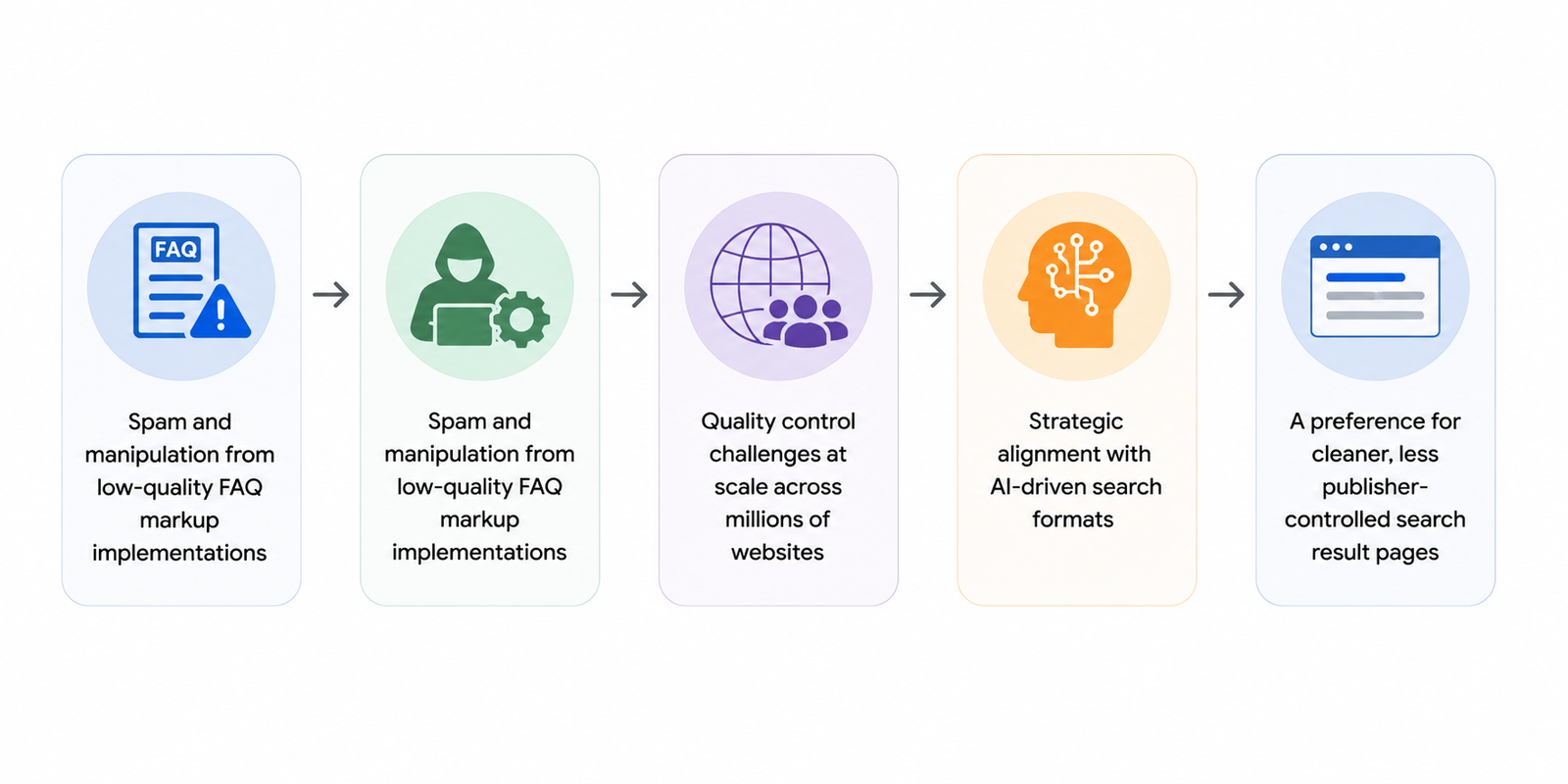
- Spam and manipulation from low-quality FAQ markup implementations
- Quality control challenges at scale across millions of websites
- Strategic alignment with AI-driven search formats
- A preference for cleaner, less publisher-controlled search result pages
How This Affects Your Current Structured Data
One important clarification: removing FAQ schema from your website is not mandatory. Google has confirmed that leaving FAQPage structured data in your code will not negatively affect your rankings or search indexing. The markup will simply have no visible effect on Google Search.
However, there are practical reasons to evaluate whether to keep it:
- Other search engines, including Bing, may still process FAQ markup for their own rich snippets
- AI search platforms including Google AI Overviews, Perplexity, and ChatGPT continue to use FAQPage markup as a citation and content signal
- Research indicates that pages with FAQPage schema are more likely to appear in AI Overviews than pages without structured data
- Keeping clean, accurate markup helps search crawling and content understanding
If your development team built performance tracking around FAQ impressions and rich result reports in Search Console, those workflows will need to be retired before June 2026.
The Impact on Search Console Reporting
For teams that tracked FAQ rich results as part of their regular SEO reporting, this update creates a gap in your data pipeline. Google will remove the FAQ search appearance filter from Search Console along with the dedicated rich result report in June 2026.
Teams should take the following steps now:
- Audit any dashboards or reports that currently include FAQ rich result metrics
- Identify replacement signals such as organic click-through rate, average position, and impression data for affected pages
- Update any API integrations that pull FAQ rich result data before the August 2026 cutoff
- Shift performance tracking focus to other available rich result types that remain active
What Structured Data Still Works in Google Search
While FAQ rich results are deprecated, structured data remains a powerful tool for search visibility. Several schema types continue to generate active rich results in Google Search.
Schema types still supported and generating SERP enhancements include:
- HowTo schema for step-by-step instructional content
- Review and rating markup for product and service pages
- Recipe schema for food-related content
- Article and NewsArticle schema for editorial content
- Product schema with pricing and availability data
- Event schema for upcoming activities and dates
- VideoObject markup for video content
- BreadcrumbList schema for site navigation
Redirecting your structured data strategy toward these schema types is a practical way to maintain search performance without depending on the now-deprecated FAQ feature.
The Role of FAQ Content in the AI Search Era
Here is where the picture becomes more nuanced. Even though FAQ rich results have been removed from traditional Google Search, FAQ content itself still carries real weight in AI-powered search environments.
AI search engines and large language models parse structured content to identify authoritative sources. When a page contains clear, well-structured question-and-answer content marked up with FAQPage schema, it signals to AI systems that the page directly addresses specific user queries.
Research from 2025 and early 2026 shows that pages with structured FAQ content were significantly more likely to surface in Google AI Overviews compared to pages without it. This trend is expected to grow as AI-referred search traffic continues to increase.
The takeaway is clear:
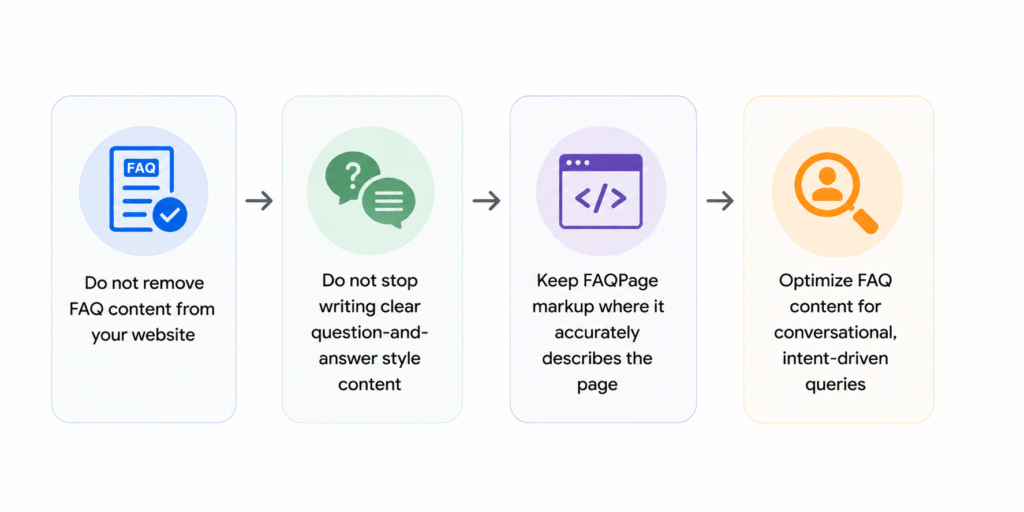
- Do not remove FAQ content from your website
- Do not stop writing clear question-and-answer style content
- Keep FAQPage markup where it accurately describes the page
- Optimize FAQ content for conversational, intent-driven queries
How AEO and GEO Strategies Must Adapt
Answer Engine Optimization and Generative Engine Optimization are now more relevant than ever. With traditional SERP features shrinking, getting cited by AI search engines becomes a primary visibility goal.
Effective AEO and GEO optimization requires:
- Writing content that directly answers specific user questions
- Using natural language that mirrors how people ask questions in voice and AI search
- Structuring content with clear headings, short paragraphs, and direct answers near the top
- Building topical authority across a subject through comprehensive, interconnected content
- Earning backlinks and citations from credible sources to signal entity relevance
- Keeping schema markup accurate so AI systems can confidently interpret page content
User intent signals now matter more than ever. Content that satisfies the full scope of a search query will outperform content that merely optimizes for keyword placement.
What This Update Reveals About Google’s Direction
This deprecation is not an isolated decision. It is part of a clear and accelerating pattern in how Google is reshaping the search experience.
Google is pulling control of search result presentation away from individual publishers and concentrating it within its own AI-generated formats. Features that gave webmasters the ability to occupy more screen space, such as FAQ dropdowns or sitelink search boxes, are being phased out.
This aligns with a broader 2026 SEO reality:
- Organic visibility is increasingly determined by content quality and topical authority
- AI Overviews are becoming a dominant search format for informational queries
- Structured data still matters, but primarily as a content comprehension signal rather than a visual enhancement trigger
- Search engine optimization now means optimizing for machine understanding, not just keyword ranking
How to Audit Your Site After This Update
With the FAQ rich result feature now inactive, a structured audit will help you assess the impact on your search performance and redirect your efforts effectively.
Recommended audit actions include:
- Run a structured data audit using Google’s Rich Results Test before it removes FAQ support in June 2026
- Pull your Search Console performance data for pages that previously had FAQ rich result impressions
- Identify which pages had the highest FAQ-driven traffic and review their organic performance now that the feature is gone
- Evaluate which schema types are still active on those pages and whether additional markup is appropriate
- Review your content strategy to ensure FAQ-style content is still present and well-optimized for AI search consumption
Content Quality Becomes the Competitive Advantage
With one of the most popular structured data shortcuts removed from the equation, website rankings will depend more heavily on the fundamental quality of your content and the strength of your topical authority.
Google has consistently signaled that well-written, authoritative content is the most durable foundation for search performance. This update reinforces that message clearly.
Priorities for content quality in a post-FAQ-rich-result environment:
- Depth of coverage on topics relevant to your niche
- Accuracy and timeliness of information
- Clear structure that helps both users and crawlers navigate content
- Natural integration of semantic entities and related concepts
- Internal linking that builds topical clusters and signals expertise
Conclusion
The end of FAQ rich results marks a genuine turning point for structured data strategy and search visibility planning. What worked as a reliable SERP enhancement for years is now inactive, replaced by a more AI-centered search landscape where content authority, schema accuracy, and user intent alignment carry the most weight.
This is not a reason to abandon structured data. It is a reason to use it more thoughtfully. Keep FAQPage markup where it genuinely describes your content, invest in the schema types that still generate rich snippets, and build content that AI search engines can confidently cite as an authoritative source.
The sites that adapt their SEO strategy to this new reality, focusing less on visual SERP tricks and more on genuine content depth and entity relevance, are the ones best positioned for lasting organic traffic and search performance in the months and years ahead.